
Contact Information

https://web.cobbk12.org/southcobb
Sunday, March 16, 2014

Organic vs. Non-Organic: What’s the Difference?
 This is part two in a series of three articles on organic foods originally published byFood Sentry on March 31, 2013. Read part one here: The Low-Down on Organic Foods.
With the basics behind us of what constitutes an organic product under the National Organic Program (NOP), we can move forward to comparing organic products with non-organic. What are the differences between the two, if any? Let’s explore.
Size and shape
When purchasing organic produce, the physical differences between organic and non-organic versions are almost instantaneously noticeable. Organic produce frequently comes in variable sizes and shapes that often look physically “imperfect,” whereas non-organic produce all seems to look relatively the same (within type, of course). But why? The short version is that much non-organic, unprocessed or minimally processed produce is treated with a variety of growth-enhancing substances and is also commonly subjected to U.S. Department of Agriculture (USDA) grading and quality standards (voluntarily), while organic produce is not. This may be changing, however, as USDA is currently working to implement similar types of physical standards under the NOP.
Similar to produce, organic meats (beef, pork, poultry, etc.), specifically cuts of meat, are often physically different from their non-organic counterparts. While cuts of organic meat have similar coloration to non-organic cuts, organic cuts are usually a bit smaller. The main reasoning for this size difference is simple: animals used for the production of organic meat products are not treated with any growth-enhancing substances commonly used in non-organic meat production, often resulting in smaller cuts.
Quality differences
Defining the “quality” differences between organic and non-organic produce and meats is difficult because of the differing values people assign to quality when it comes to food. In a nutshell, organic food products must meet the same standards that apply to non-organic foods, but the organic food products must meet an additional set of standards (the NOP) that do not apply to non-organic products. Additionally, organic products are required to be certified as meeting these extra standards, while participation by non-organic product producers in many of the basic USDA-established standards and certifications is not required (though many do participate).
Back to our original question: is there a quality difference between organic and non-organic products? Well, if you as an individual attribute low environmental impact, minimal additive and synthetic-substance use, as well as stricter regulation of farming practices with greater “quality” in the food you eat, then organic products would probably generally register as such. On the other hand, if you as an individual associate attributes such as higher product consistency, greater size and more “perfect” physical characteristics with greater “quality” in the food you eat, then organic products probably would not represent a higher-quality product to you.
Also, although a lot of people believe that organic products are nutritionally superior to non-organic products, some very recent studies have shown that the nutritional differences between organic products and non-organic products are generally minuscule, although research on the topic is ongoing.
Food additives, pesticides and other substances
Perhaps the most substantial and tangible differences between organic products and non-organic products lie in the various substances used in non-organic food production that are not in organics. Under the NOP, the use of certain modification methods, pesticides and other synthetic substances on food plants, as well as the use of food additives, fortifiers and substances that may be used as processing aids in organic products, are strictly limited to legislation-identified methods, substances and uses (see exceptions here: Substances and methods list).
Additionally, animals used to produce organic products such as eggs, cheeses, meats, etc., are raised on organic feeds without the use of antibiotics (except in certain atypical circumstances), growth-enhancing substances and other various artificial substances and modification methods. In the end, all of these things mean that, in theory, organic products contain, if any, far fewer artificial ingredients (e.g., preservatives and pesticide and/or antibiotic residues, etc.) than their non-organic counterparts.
A market divided
At this point, you’re armed with most of the information necessary to better judge and understand the organic food market. However, knowing about the numerous physical, visual, qualitative and compositional differences between organic and non-organic products is only the second part of the organics puzzle.
© Food Safety NewsFNW....Food Safety and Sanitation
Dole Expands Bagged Salad Recall to the U.S. Over Listeria Concerns
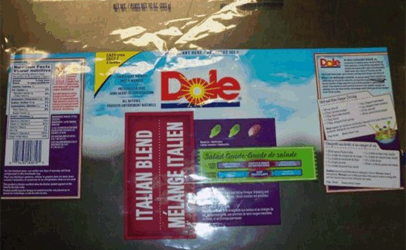 Dole Fresh Vegetables has expanded to the U.S. its voluntary recall of bagged salad afterinitially issuing a recall in Canada. The concern is that some of the products may be contaminated with Listeria monocytogenes.
The products being recalled are Dole Italian Blend (UPC 7143000819), Fresh Selections Italian Style Blend (UPC 1111091045), Little Salad Bar Italian Salad (UPC 4149811014) and Marketside Italian Style Salad (UPC 8113102780) coded A058201A or B, with use-by date of March 12, 2014.
The product code and use-by date are in the upper right-hand corner of the package; the UPC code is on the back of the package below the barcode.
The salads were distributed in 15 U.S. states: Connecticut, Florida, Illinois, Indiana, Kentucky, Maryland, Massachusetts, Michigan, New Jersey, New York, North Carolina, Ohio, Pennsylvania, South Carolina and Virginia. They were also distributed in three Canadian provinces: New Brunswick, Ontario and Quebec.
No illnesses have been reported in association with the recall. However, due to the time involved in tracing a foodborne illness back to a specific food product, it is impossible to say whether or not anyone has fallen ill.
The recall was issued after one sample of Dole Italian salad yielded a positive result for Listeria monocytogenes in a random sample test conducted by the Canadian Food Inspection Agency.
Although the product is past its use-by date, retailers should check their inventories and store shelves to confirm that none of the product is mistakenly present or available for purchase by consumers or in warehouse inventories. Dole Fresh Vegetables customer service representatives are already contacting retailers and are in the process of confirming that the recalled product is being removed from the stream of commerce.
Listeria monocytogenes is an organism that can cause foodborne illness in a person who eats a food item contaminated with it. Symptoms of infection may include fever, muscle aches and gastrointestinal symptoms such as nausea or diarrhea. The illness primarily impacts pregnant women and adults with weakened immune systems. Most healthy adults and children rarely become seriously ill.
© Food Safety NewsFNW: March 17-21, 2014
Standards: HUM-FNW-8 Compare
the causes and foods at risk for illnesses.
HUM-FNW-7 Analyze food safety and
sanitation procedures from production to consumption.
ESSENTIAL QUESTION: How can a food-borne
illness be prevented?
Opening Warm-up AND/OR Activator (highlight
one): Bellwork:. Personal Hygiene (p.56) Students will read the
prompt and complete the student. *share responses*
Work Session: 1.Students will watch DVD: Germs and
Viruses: Complete Film Review 10 things I learned, 3 things I can apply to my
everyday life,
2. Complete Foodborne Article
Reviews (Share with the class)
3. Students will work on Chapter 5
Key Concepts questions 1-15. *use textbook to find the answers*
4. ServSafe worksheet: TBD
Closing/Summarizer: Teacher will show video clip: UC
DAVIS Food Safety-Stomache Tonight/ Film Review
Daily Homework: none
Tuesday, March 18, 2014
USC Davis Food Safety music video:
Who left the food out?
Work Session: 1. Students will share Article Reviews.
2. Chapter 5 Key Concept
Questions
3. ServSafe handout: TBD
4, Chapter 5 handouts p.35: Test
Taking p.36 Content and Academic Vocabulary
Daily Homework: none
Wednesday, March 19, 2014
Standards: HUM-FNW-8 Compare
the causes and foods at risk for illnesses.
HUM-FNW-7 Analyze food safety and
sanitation procedures from production to consumption.
Opening Warm-up AND/OR Activator (highlight
one): Bellwork: Toxin (p.55)
Students will read the prompt and answer the student activity.
Work Session: 1. Teacher will discuss Creepy Critters
Animated Technology Project. Students will research a Bacteria or Parasite using
guided research questions to create a technology presentation. Students will be
graded using a powerpoint rubric.
UC DAVIS Food Safety video: Who let the
dogs out.
2. Check and discuss Chapter 5 Key
Concept Questions
3. Handout: Not so Safe Supper
4. Serve Safe Handouts: Storing
Food at the Proper Temperature
Closing/Summarizer: 3-2-1:
three things they learned about fooborne illnesses, 2 things they will use at
home, 1 I wonder about this:
Daily Homework: Creepy Critters Technology
Project
Thursday, March, 20, 2014
EQ:
Why would we study food safety in the kitchen?
Opening Warm-up AND/OR Activator (highlight
one): Students will answer:
What is the temperature danger zone?
Work Session:1. Activity:
Teacher will show students how to find food inspection reports online and how
to navigate a food inspection report.
- Students will work in groups of 3
or 4 to compare 3 different food inspection questions with guided questions.
Students wills share results/responses.
Daily Homework:none
Friday, March 21, 2014
Standards: HUM-FNW-8 Compare
the causes and foods at risk for illnesses.
HUM-FNW-7 Analyze food safety and
sanitation procedures from production to consumption.
Opening Warm-up AND/OR Activator (highlight
one): List the 1st
and 3rd step for the handwashing procedure. *sticky note*
UC DAVIS Food Safety video: Who
left the food out!
Work Session: Teacher will
discuss Creepy Critters Animated Technology Project. Students will research a
Bacteria or Parasite using guided research questions to create a technology
presentation. Students will be graded using a
powerpoint rubric. Q & A
UC DAVIS Food Safety video: Who let the
dogs out.
1. Students
will work on ServSafe handout: Preventing Time- Temperature Abuse During
Storage Fact Sheet. (packet)
2 Students will work on ServSafe
Handout: Cooling & Reheating Food Fact Sheet. (packet)
Chapter 6
Kitchen Safety
Ktchen
Safety DVD- Students will complete guided questions with the video.
.
Daily Homework:none
Sunday, March 9, 2014
FNL
Monday, March 10, 2014
1. Complete Origin of food presentations.
2. Complete, check and grade Chapter 2 assignments.
1. Complete Origin of food presentations.
2. Complete, check and grade Chapter 2 assignments.
Links for FNW..Chapter 5 and Chapter 6 ( Food and Safety Unit)
http://www.foodsafety.gov/
http://www.foodsafetynews.com/
http://www.foodsafetynews.com/
Subscribe to:
Posts (Atom)
-
Monday, 10-13-14 Standards: HUM-FL-3 Design and demonstrate a nutritious diet. 3.1 Define and demonstrate an understanding of the c...
-
Food Evaluation Vocabulary Test: Thursday 2.9.17
